Who owns your battery passport?
The obligation lands on whoever places the battery on the EU market. If you import your packs, that is you, not your supplier.
Ask most e-bike, LEV, or storage brands who is on the hook for their battery passport, and a lot of them point at their supplier. That is the single most common wrong answer we hear. If you import finished packs from Asia and sell them under your own brand in the EU, the passport obligation is yours, not your factory's.REG. (EU) 2023/1542, ART. 77(4)
The rule, plainly
The regulation puts the duty on one party: whichever economic operator places the battery on the EU market. That operator has to make sure the passport is accurate, complete, and kept up to date, for the life of the battery.ART. 77(4)
The same operator is also the one who attributes the battery's unique identifier, the code behind the QR that the passport hangs off. It is not assigned by a registry or by the factory that welded the cells. It is attributed by whoever puts the battery on the EU market.ART. 77(3)
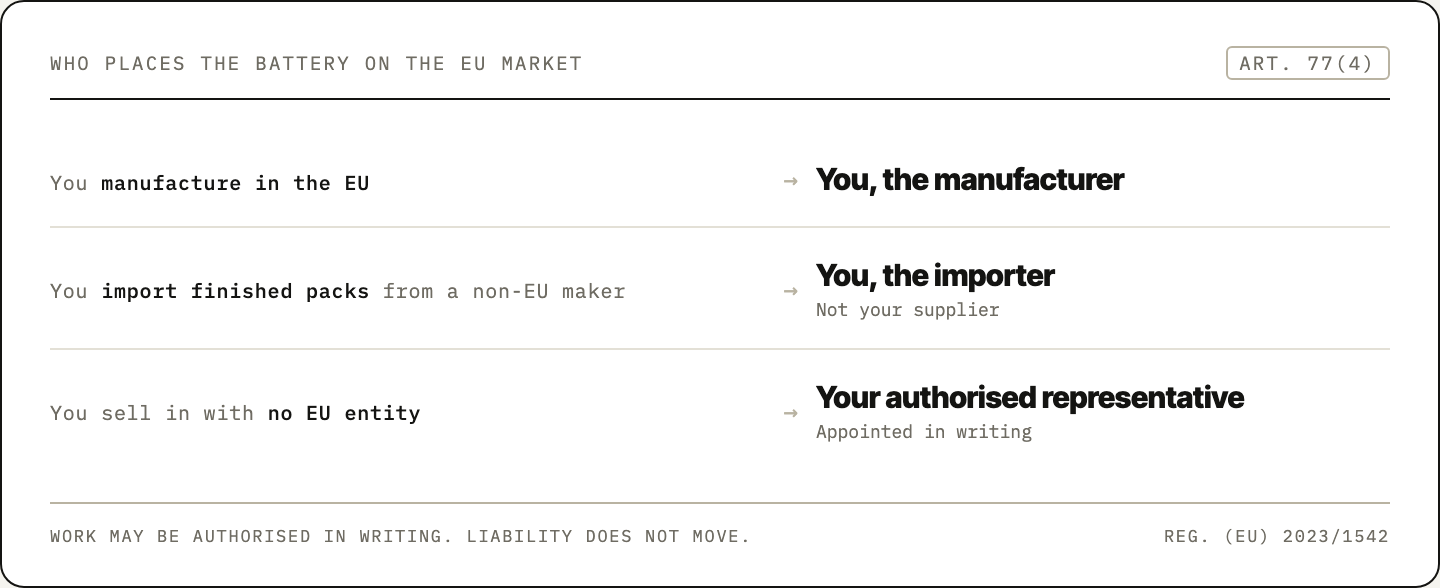
Manufacturer, importer, or authorised representative
Who counts as "the economic operator placing the battery on the market" depends on where your business sits relative to the EU border. This is not a battery-specific quirk. It is the ordinary way EU product law assigns responsibility to whichever party actually has control over the product before it reaches EU customers:
- You manufacture in the EU: you are the manufacturer, and the obligation sits with you directly.
- You import a finished battery from a non-EU manufacturer: the manufacturer is outside the EU, so the duty shifts to you, the EU-based importer. This is the situation most e-bike, LEV, and storage brands are actually in, and it is the part the "only automakers are affected" myth misses entirely.
- You sell into the EU with no EU entity at all: you need an authorised representative, an EU-established party you name in writing to carry the obligation on your behalf.
Read that against Article 77 itself: the duty attaches to "the economic operator placing the battery on the market," full stop.ART. 77(4) Whether that is you, an importer you didn't know you needed, or a representative you haven't appointed yet is a question worth answering before February, not after.
You can authorise the work. You can't authorise away the liability.
The regulation gives you an out for the work, not for the obligation. Read the two sentences of Article 77(4) side by side:
"The economic operator placing the battery on the market shall ensure that the information in the battery passport is accurate, complete and up to date. It may give written authorisation to any other operator to act on its behalf."ART. 77(4)
The first sentence names who has to ensure the passport is right. The second sentence lets you hand someone else the pen, in writing, to act on your behalf. It does not say the obligation moves with the pen. If your supplier fills in the passport and gets it wrong, the economic operator named in the first sentence is still the one who was supposed to ensure it was accurate. That distinction, act on your behalf versus stand in your place, is worth pinning to the wall of anyone at your company who thinks a supplier contract makes this someone else's problem.
"On the market" also means "in service"
The scope line does not stop at sale. It reads "placed on the market or put into service."ART. 77(1) If you build your own e-bike fleet, run your own swap stations, or deploy an energy storage system for internal use, you have put those batteries into service in the EU. There is no checkout, no invoice to a third party, and the obligation still applies. Keeping the batteries in-house is not a loophole.
The one question we won't guess at
Here is a case the text does not spell out cleanly: an EU-based OEM buys finished battery packs from another EU-based company and sells them under its own brand. Both parties are inside the EU. We have not found official guidance that names which of the two carries the obligation in that specific configuration, and we are not going to invent an answer to sound authoritative. If that is your situation, say so honestly in your own risk assessment, and treat it as an open question until a regulator or standards body closes it. The free readiness checker won't resolve that gap either, but it will tell you where the rest of your obligations stand.
What to do with this
Work out, in writing, which of the three roles above you actually hold today. If it's importer, that is not a technicality, it is the whole obligation. Then take the free battery passport readiness checker, twelve questions, about three minutes, no signup, and see the gap report against what Annex XIII actually expects from you.
General information, not legal advice. Verify obligations against the cited regulations on EUR-Lex, or with counsel. Citations checked August 10, 2026.