Does the battery passport apply to your e-bike?
LMT batteries are in scope at every size. The 2 kWh threshold people quote belongs to industrial batteries, and getting that wrong is common.
| MEASURE | FIGURE | SOURCE |
|---|---|---|
| LMT (e-bike) battery passport required from | 18 FEB 2027 | REG. (EU) 2023/1542, ART. 77(1) |
| Capacity threshold (industrial batteries only) | 2 kWh | REG. (EU) 2023/1542, ART. 77(1) |
| Typical e-bike battery pack | 0.4-0.9 kWh | EDITORIAL ESTIMATE |
Yes, at every size. If you place an e-bike, e-scooter, or e-moped battery on the EU market from 18 February 2027, it needs its own battery passport. There is no capacity floor to duck under.REG. (EU) 2023/1542, ART. 77(1)
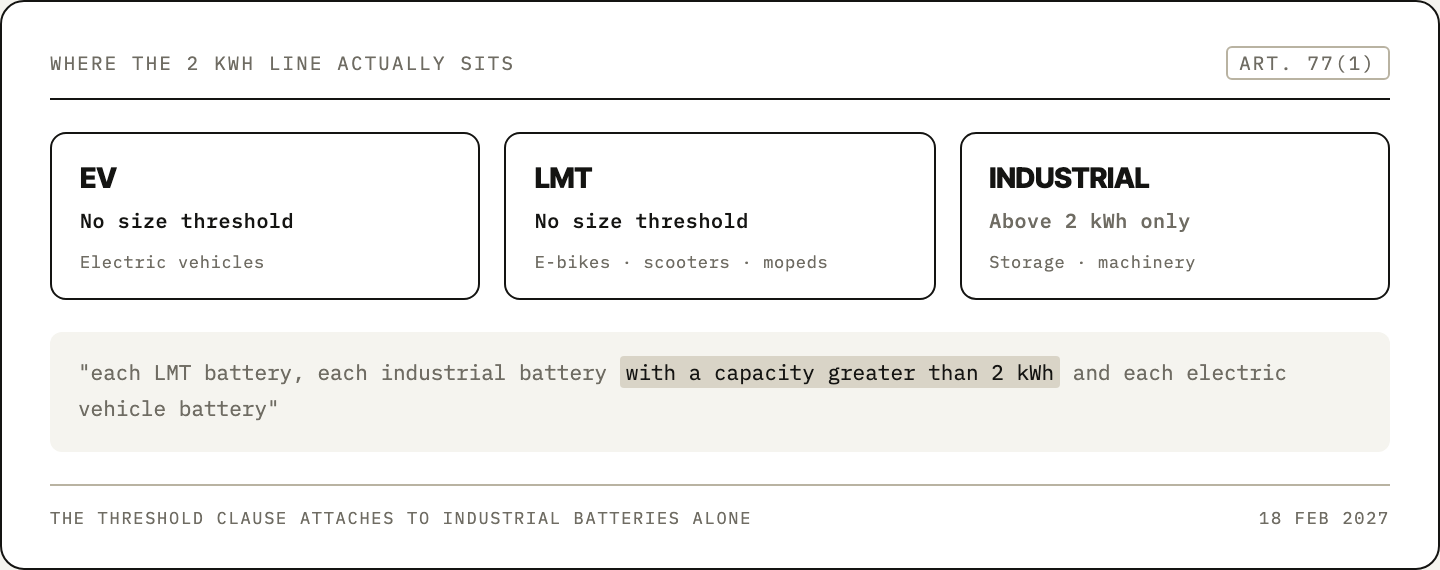
The article's own wording settles it: "From 18 February 2027 each LMT battery, each industrial battery with a capacity greater than 2 kWh and each electric vehicle battery placed on the market or put into service shall have an electronic record ('battery passport')." Read the clauses slowly. The capacity qualifier, "with a capacity greater than 2 kWh," sits directly after industrial battery and nowhere else. LMT batteries and EV batteries are named with no threshold at all.ART. 77(1)
What "LMT" means here
LMT stands for light means of transport. In the regulation's own terms, an LMT battery powers a wheeled vehicle that can move under electric motor alone or under a combination of electric motor and human power. That covers e-bikes, e-scooters, and e-mopeds, whether the motor assists your pedaling or drives the vehicle by itself.
Where the 2 kWh line actually sits
Three battery categories are bound by the passport rule, and the capacity threshold attaches to exactly one of them:
- EV batteries: no threshold.
- LMT batteries: no threshold.
- Industrial batteries above 2 kWh: the only category the figure belongs to.
A typical e-bike pack runs roughly 0.4 to 0.9 kWh, well under 2 kWh. That is exactly why the misreading feels plausible: the number is real, the pack size is real, and "my battery is smaller than the threshold" sounds like a clean argument. It just applies the wrong category's rule to yours.
What you'll read elsewhere
This is one of the more common errors circulating in published battery-passport summaries. Some apply the 2 kWh threshold to LMT batteries directly, waving e-bikes out of scope on capacity alone. Others drop LMT out of the scope sentence entirely and describe the rule as covering only EV and industrial batteries, which quietly removes an entire category rather than misreading one number. Both versions lead a brand to the same wrong conclusion. We won't name the source; the fix is the same regardless of where you read it. Go back to the article text above and check which noun the threshold clause is actually attached to.
What being in scope actually requires
A passport per battery, not per model. Each unit needs a unique identifier reachable through a printed QR code, linking to that specific battery's own record.ART. 77(3) · ART. 13(6)
That record carries the model-level and unit-level data set out in Annex XIII: identity, chemistry, performance, and the rest, scaled to what an LMT battery actually is.ART. 77(2) · ANNEX XIII
If you make LMT batteries
Confirm scope first, correctly, and move on to the parts with long lead times: carbon footprint data, recycled-content sourcing, and registry access. The battery passport deadline, explained walks through what every in-scope battery needs. The free readiness checker turns your specifics into a prioritized gap report in about three minutes. No signup; answers stay in your browser.
General information, not legal advice. Verify obligations against the cited regulations on EUR-Lex, or with counsel. Citations checked August 10, 2026.