SAGAS Compliance
Battery passports you can set up yourself: no consultants, no sales call. Validated against Annex XIII, hosted behind the printed QR, and filed with the EU registry.
DEADLINE 18 FEB 2027 · 146 DAYS · EV · LMT · INDUSTRIAL >2 kWh
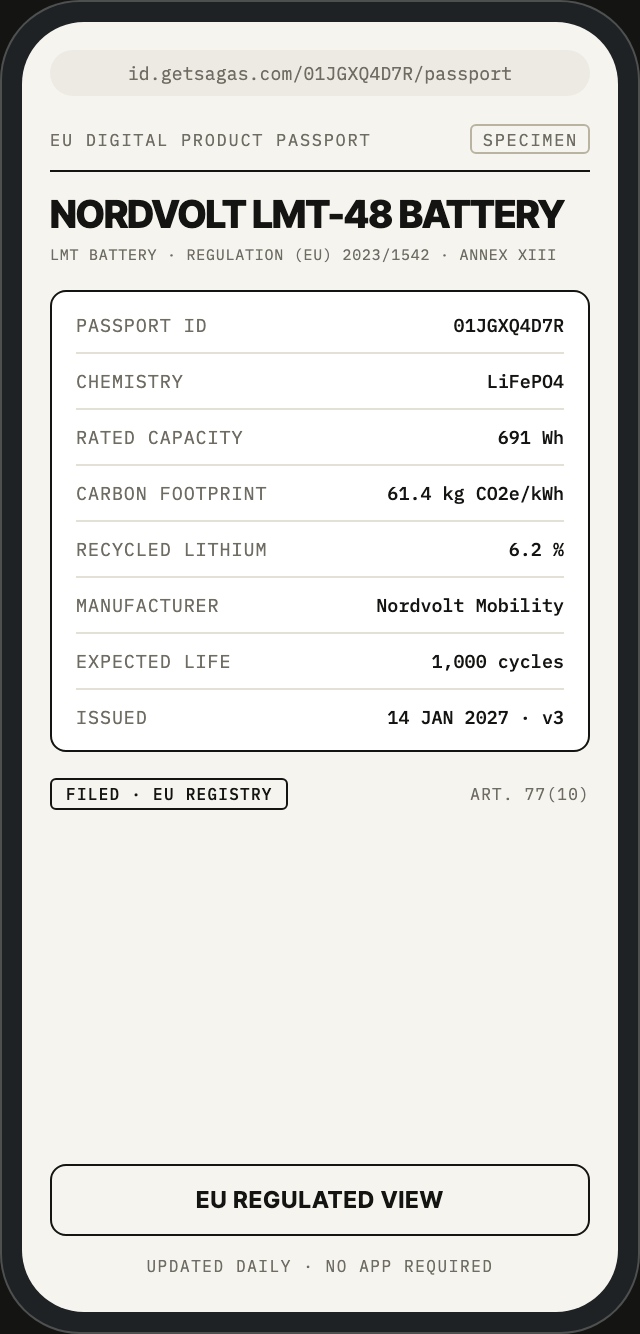
The passport, explained.
01
A record per battery
Every battery placed on the EU market gets its own digital record: identity, chemistry, capacity, carbon footprint, recycled content. Per battery, not per model.ART. 77(1) · ANNEX XIII
02
Behind a printed QR
One printed QR on the battery links to its passport page. Public fields for anyone who scans; restricted tiers for regulators, recyclers, and repairers.ART. 77(3) · ART. 13(6)
03
Ready for the registry
The European Commission's central registry went live on 20 July 2026; battery registration is not open yet. From 18 February 2027, no passport means no lawful sale.ART. 77(10)
04
A living document
Not one-time paperwork: the passport stays online and stays current for the battery's life. Updates, versioning, and audit history are the ongoing job.ART. 77(4), (7)
Buy your packs from Asia? The passport is yours.
The obligation lands on whoever places the battery on the EU market. EU manufacturer: it's them. Imported packs: it's you, the importer, not your supplier (Regulation (EU) 2023/1542). Delegating the work is allowed. Delegating the liability is not.
Ready before February.
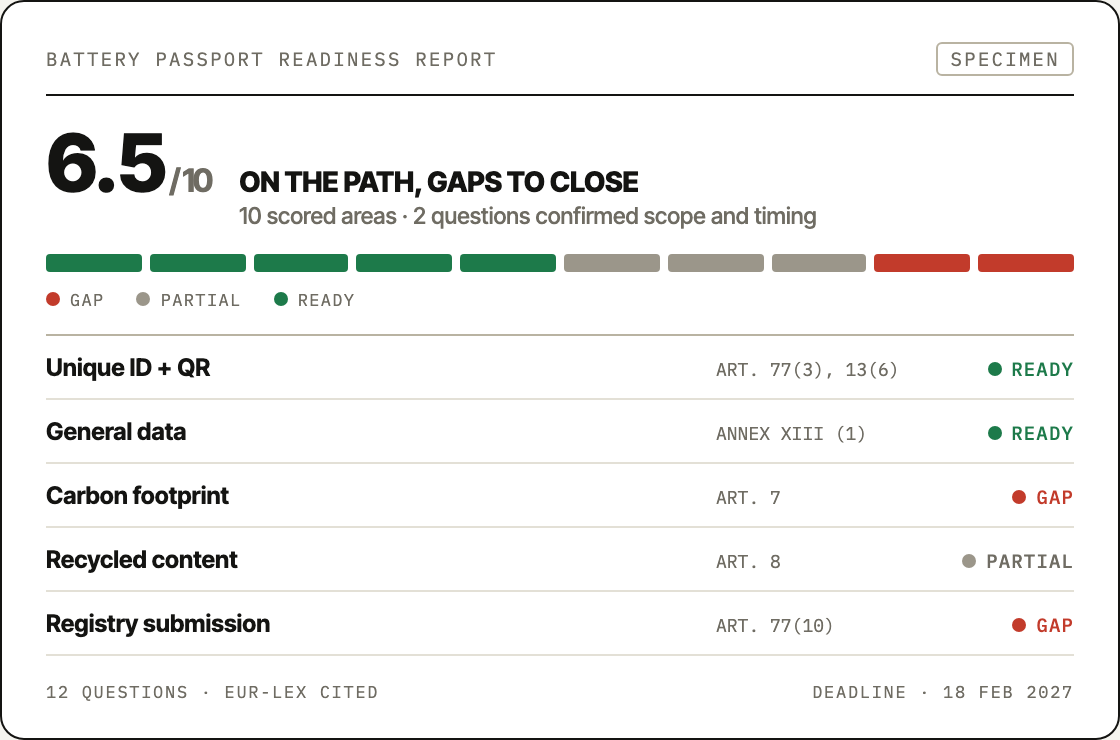
The checker stays free: 12 questions, about 3 minutes, no signup. Your gap report renders in the browser, sorted by lead time. Prefer to talk it through? Book a free 20-minute gap review. See the plans and prices.
The questions everyone asks.
Is the battery passport actually mandatory?
Yes. EV batteries, LMT batteries (e-bikes, scooters), and industrial batteries above 2 kWh placed on the EU market or put into service from 18 February 2027 each need a digital battery passport (Regulation (EU) 2023/1542, Art. 77(1)). It binds per battery, not per model.
We import our packs from Asia. Whose obligation is the passport?
Yours. When the battery's manufacturer is outside the EU, the importer placing it on the EU market is the responsible economic operator. You can delegate the work in writing; you cannot delegate the liability (Regulation (EU) 2023/1542, Art. 77).
Does the due-diligence reporting apply to us?
Probably not. The supply-chain due-diligence policy obligation binds economic operators with net turnover above €40M, and it was postponed to 18 August 2027 by Regulation (EU) 2025/1561. A proposal to raise that threshold to €150M is still in negotiation, so treat the line as current but not settled. The passport itself applies regardless of your size. The free checker tells you which applies to you.
We ship before the deadline. Are we off the hook?
Batteries placed on the market or put into service before 18 February 2027 don't need a passport. Anything placed from that date on does, including new units of models you already sell today.
What happens if we're not ready?
From 18 February 2027, in-scope batteries can't lawfully be placed on the EU market or put into service without a passport (Art. 77(1)): the deadline blocks shipments, not just paperwork. Enforcement and penalties are set by each member state.
Can't our consultant handle it?
A consultant can assemble the data once. The passport is a living document: it has to stay online, stay current, and be filed with the EU registry. SAGAS Compliance is built for the ongoing part, and the free checker tells you exactly what to hand whoever does the one-time part.
What if the rules change again?
Several implementing acts are still pending. Passports on SAGAS will be versioned against the rule set they were issued under and update when the schemas change. Watching EUR-Lex is our job, not yours.
Why pay when free DPP tools exist?
Most free tools generate a passport web page and stop there. They don't check your data against the Annex XIII fields, so what you get looks finished until someone reads it properly. What you pay for is a hosted passport built against the real attribute set, with your gaps named rather than rounded up, and a signed record behind it. Filing goes in the day the Commission opens battery registration; nobody can file before then, whatever they claim.
What does it cost?
From €49 per month, on the page, with no quote form and no sales call. The optional gap review is exactly that: optional. The readiness checker stays free either way.
General information, not legal advice. Verify your obligations against Regulation (EU) 2023/1542 and its implementing acts, or with counsel. Citations checked against EUR-Lex, July 30, 2026.