The hard part is not the software
Four independent studies say the same thing: passport projects stall on supplier data, not on tooling. What that means for a six-month runway.
Most teams start a battery passport project by shopping for software: compare vendors, book demos, pick a platform, backfill the data later. The evidence says that order is backward. Passport projects don't stall on tooling. They stall on getting data out of suppliers.
The readiness gap
KPMG's European Digital Product Passport Readiness Survey (2026) polled more than seventy organisations across Europe, in sectors including batteries and energy storage. Ninety-seven percent said they're aware of DPP requirements. Only thirty-three percent said they have meaningful understanding of what's required. Eighty-one percent said they lack the structured lifecycle data compliance depends on. (Figures are survey-wide; we worked from the summary, not a sector breakdown, so treat any split by industry as approximate.) The gap isn't awareness. It's data.
What the interviews found
CEPS's In-Depth Analysis 2024-05 (Rizos and Urban, March 2024), produced under the EU-funded BATRAW project, is built on roughly hour-long interviews with sixteen companies across the battery value chain, conducted August 2022 to April 2023. The recurring blockers: data collection is genuinely hard, companies are reluctant to share commercially sensitive figures, there's no interoperability standard to collect the data into, and end-of-life responsibility is unclear. Some interviewees called the 2027 timeline ambitious. The interviews close in April 2023, so read this as a record of that period, not current sentiment.
CIRPASS Deliverable D5.2 (5 March 2024) found the same shape of problem from the vendor side: eight semi-structured interviews, four DPP service providers and four SMEs, conducted in the second half of 2023, explicitly qualitative rather than a statistical survey. Its own words: "all potential DPP service providers are reluctant to provide quantitative figures due to commercial reasons and sometimes, they just don't know yet." There is no reliable public price benchmark for passport work. Treat any vendor's confident cost table with suspicion.
The cost is mostly fixed, and mostly data
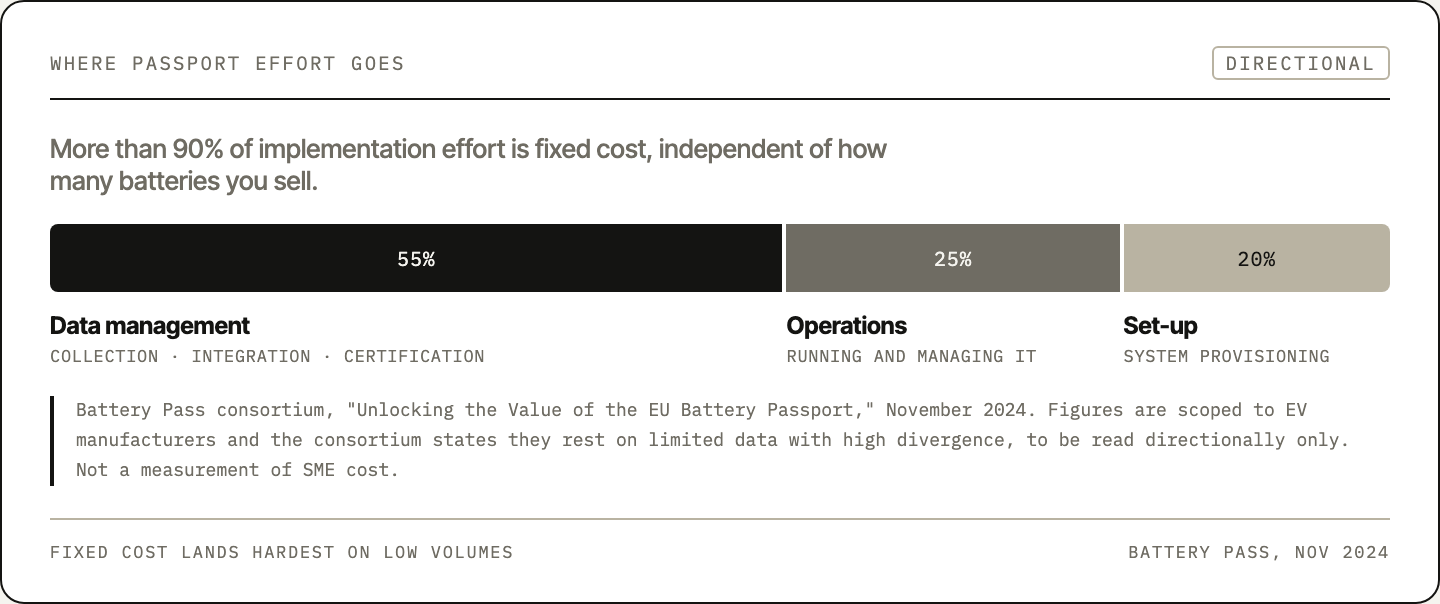
The Battery Pass consortium, led by Systemiq with acatech, BMW Group, Audi, BASF, Umicore, Circulor, TWAICE, Fraunhofer IPK, and others, funded by the German federal economics ministry, published "Unlocking the Value of the EU Battery Passport" in November 2024. Its headline finding: more than ninety percent of implementation effort is fixed cost, independent of sales volume, and roughly fifty-five percent of total effort goes to data management.
Two caveats the consortium states about its own numbers: the cost figures are scoped to EV manufacturers specifically, and the values are based on limited data with high divergence between companies, so read them directionally, not as precise benchmarks. Don't carry the percentages over to an SME operation as though they were measured there. What does carry over is the shape of the finding: passport cost is mostly fixed, which is exactly why it lands hardest on low-volume producers. The report names third-party service providers who spread that fixed cost across clients as one way EV makers are addressing it.
Why supplier data moves slowly
None of this is a software failure, it's structural. Requests travel up multi-tier supply chains where lead times run in weeks, and the person who holds your cathode chemistry figures usually isn't the person who answers your email. The numbers you need, material shares, emissions factors, supplier identities, are exactly what a supplier least wants a customer, and potential competitor, to see. And there's no shared format to collect it in, so someone on your side reconciles it by hand. A platform can display data the moment you have it. It can't make a supplier answer faster.
What to do with six months left
On 18 February 2027, the obligation switches on for batteries in scope.REG. (EU) 2023/1542, ART. 77(1) From then, the regulation requires that passport information stay accurate, complete and up to date, so data governance doesn't end at launch; it's the ongoing job.ART. 77(4) With that much runway left, sequencing beats shopping: map who inside your supply chain actually holds each data point, send the requests now given the lead times above, and work out what you can source yourself versus what only a supplier can provide. Choose software once you know the shape of your gap, not before.
The free readiness checker turns twelve questions into a gap report against Annex XIII in about three minutes, so you can see your own gaps before you shop for anything. No signup; answers stay in your browser.
General information, not legal advice. Verify obligations against the cited regulations on EUR-Lex, or with counsel. Citations checked August 10, 2026.