Second life, second passport
Repurpose or remanufacture a battery and it needs a new passport linked to the original, with the obligation transferred to you.
Most battery passport guidance assumes a straight line: one manufacturer places a battery on the EU market, and that same company carries the passport for the battery's life. Regulation (EU) 2023/1542 does not assume that. Prepare a battery for re-use, prepare it for repurposing, repurpose it, or remanufacture it, and the regulation treats what comes out the other end as a new product, with its own new passport and a new party responsible for it.REG. (EU) 2023/1542, ART. 77(7)
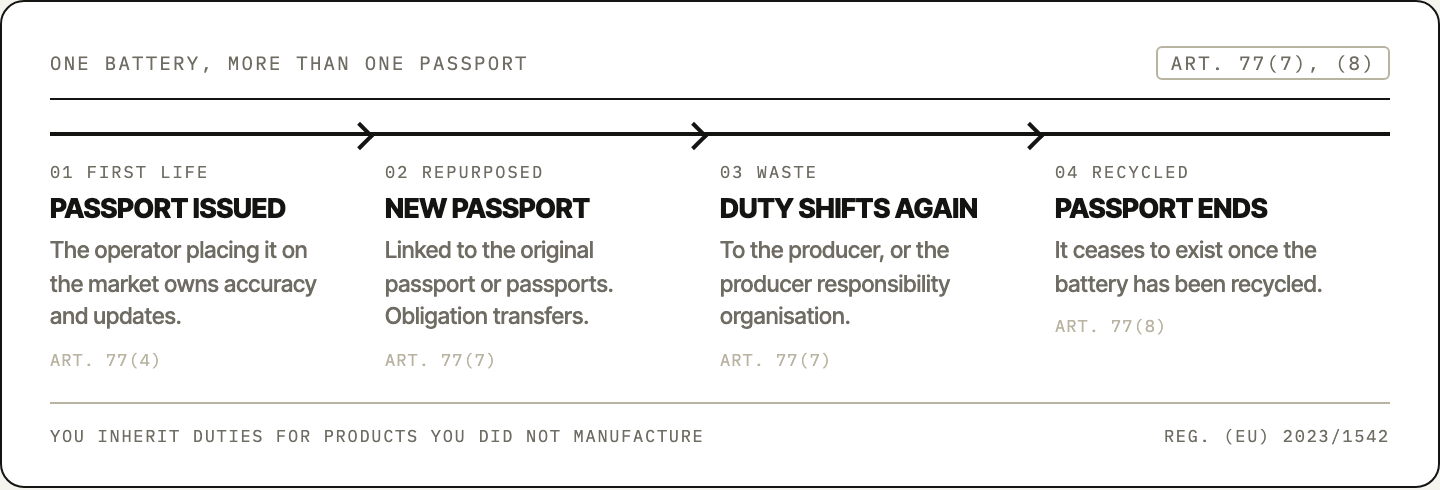
The four routes that trigger a new passport
Article 77(7) names four routes: preparation for re-use, preparation for repurposing, repurposing, and remanufacturing. In practical terms these span a range, from cleaning up and reselling a pack largely as it is, through pulling a pack apart and reassembling the working cells into a new one, to rebuilding a battery back to its original specification. The regulation does not treat that range as one continuous life with one passport. Cross any of those lines and you are placing what the law calls a new battery on the market, not servicing a used one.ART. 77(7)
The obligation moves with the battery
Here is the operative sentence: "For a battery that has been subject to preparation for re-use, preparation for repurposing, repurposing or remanufacturing, the responsibility for the fulfilment of the obligations under paragraph 4 of this Article shall be transferred to the economic operator that has placed that battery on the market or has put it into service."ART. 77(7)
"The obligations under paragraph 4" is doing a lot of work in that sentence, so it is worth reading paragraph 4 directly: "The economic operator placing the battery on the market shall ensure that the information in the battery passport is accurate, complete and up to date. It may give written authorisation to any other operator to act on its behalf."ART. 77(4) Put together, the two paragraphs say the same duty that binds an original manufacturer, keeping the passport accurate, complete, and current, lands on you the moment you place a prepared, repurposed, or remanufactured battery on the market. You did not build the cells. You still own the passport.
The new passport has to link back, and it may need to link to more than one original
The same provision continues: "Such battery shall have a new battery passport linked to the battery passport or passports of the original battery or batteries."ART. 77(7) Read that plural carefully. Repurposing work often consolidates modules or cells from more than one original pack into a single new battery, and the text anticipates exactly that: your new passport may need to link to several original passports, not one. That linkage requirement has a practical precondition most operators will not see coming from the text alone: you can only link to a passport you can read and retain. If an incoming battery's original passport is missing, stale, or handed to you as a PDF instead of structured data, that gap becomes a gap in the passport you are about to issue.
When the battery becomes waste, the chain moves again
The obligation does not stay with the second-life operator forever. Article 77(7) also addresses what happens once a battery's status changes to that of a waste battery: responsibility for the paragraph 4 duties shifts again, this time to the producer or, if one has been appointed for that scheme, the producer responsibility organisation.ART. 77(7) The chain of custody the regulation is building runs from original manufacturer, to whoever places a repurposed or remanufactured battery on the market, to the producer or producer responsibility organisation once the battery is waste. Each transfer carries the same duty forward to whoever is actually in a position to discharge it.
A passport does not outlive the battery
That chain has an end. "A battery passport shall cease to exist after the battery has been recycled."ART. 77(8) The passport's life is bounded by the battery's: it does not need to be maintained, transferred, or archived indefinitely once the battery itself is gone.
What this means if you run a second-life operation
If your business preps batteries for re-use, repurposes packs, or remanufactures units for the EU market, the passport rule reaches you twice. You are a reader of passports before you are an issuer of one: whatever the original manufacturer recorded, or failed to record, arrives with the battery, and Article 77(7) makes you responsible for what you build on top of it. That makes incoming data quality a commercial question, not just a compliance one. A battery that arrives with a thin, outdated, or unreadable passport costs you time you did not budget for, checking, requesting, or reconstructing what should already be there before you can issue a compliant passport of your own. None of that requires assuming the second-life sector is behind. It is a new obligation, first applying to in-scope EV, LMT, and industrial batteries from 18 February 2027, and reading incoming passports as carefully as you will one day issue your own is simply the prudent way to meet it.ART. 77(1)
The free readiness checker is built for first-time issuers, but the same twelve questions are a fast way to see what a compliant passport needs to contain, whether you are completing one for a battery you built or one you are giving a second life.
General information, not legal advice. Verify obligations against the cited regulations on EUR-Lex, or with counsel. Citations checked August 10, 2026.