The dates that actually bind you
Four battery deadlines land between 2026 and 2028. Only one requires a passport, one was postponed, and one exempts most SMEs.
| OBLIGATION | FIGURE | SOURCE |
|---|---|---|
| Battery passport requirement | 18 FEB 2027 | REG. (EU) 2023/1542, ART. 77(1) |
| Separate collection symbol | 18 AUG 2025 | ART. 13(4) |
| General information and capacity labels | 18 AUG 2026 | ART. 13(1) TO (3) · ART. 13(10) |
| Due diligence obligations, postponed | 18 AUG 2027 | REG. (EU) 2025/1561 |
| Carbon footprint declaration, LMT | 18 AUG 2028 | ART. 7 |
| Due diligence SME exemption threshold | €40 million | REG. (EU) 2023/1542, ART. 47 |
Every battery timeline you've seen prints as a flat list: labelling in August 2026, passports in February 2027, due diligence sometime after that. Flat lists hide something the regulation itself does not hide. Several of those dates are not dates. They are floors, written as "date X, or N months after the entry into force of a Commission act, whichever is the latest." One of them has already moved. The passport date has not, and it is not written that way at all.
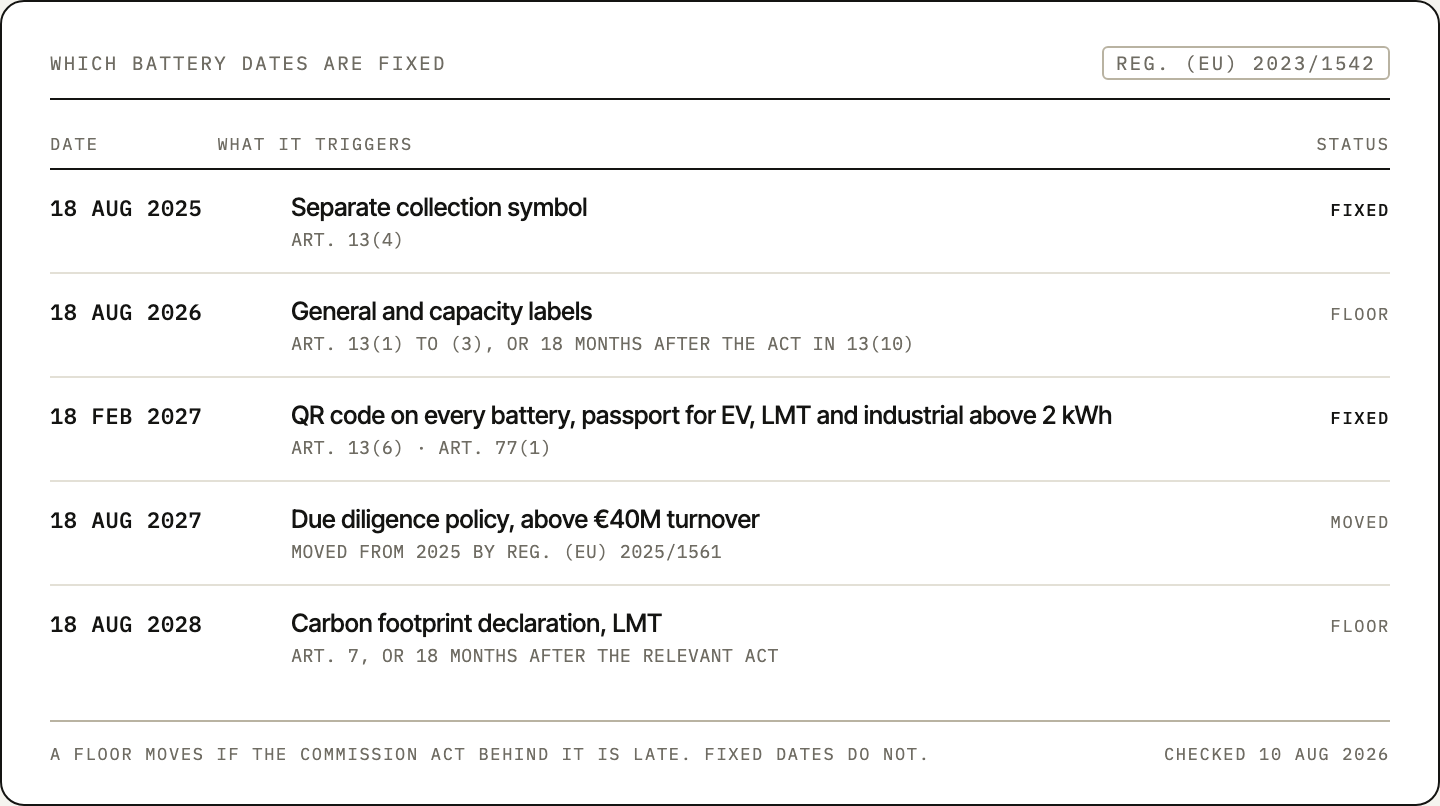
The dates that do not move
Article 77(1) sets the passport requirement in one unconditional sentence: "From 18 February 2027 each LMT battery, each industrial battery with a capacity greater than 2 kWh and each electric vehicle battery placed on the market or put into service shall have an electronic record ('battery passport')." No "or." No Commission act to wait on. Just a date.REG. (EU) 2023/1542, ART. 77(1)
The QR code obligation next to it reads the same way. From 18 February 2027, every battery has to carry a QR code under Annex VI, and for LMT, industrial batteries above 2 kWh, and EV batteries, that code is what gives access to the passport. Worth noting: the QR requirement covers every battery sold in the EU, not only the three categories that need a passport behind it. What sits behind the code differs by category; the code itself does not.ART. 13(6)
A third unconditional date already came and went: from 18 August 2025, every battery has carried the separate collection symbol.ART. 13(4) No "or" clause there either. That one is not a floor to plan around. It is already law.
The dates that can move
Contrast that with how Article 13 sets the labelling deadline. The general information label and the capacity label apply "from 18 August 2026 or 18 months after the date of entry into force of the implementing act referred to in paragraph 10, whichever is the latest." Paragraph 10 required the Commission to adopt those harmonised labelling specifications by 18 August 2025. The "18 August 2026" figure everyone quotes is only true if that implementing act showed up on schedule. It is a floor, not a commitment.ART. 13(1) TO (3) · ART. 13(10)
The carbon footprint declaration is built the same way, just phased by category. It applies from 18 February 2025 for EV batteries, 18 February 2026 for rechargeable industrial batteries other than those with exclusively external storage, and 18 August 2028 for LMT batteries, and in every case the regulation adds an "or": 12 months after the relevant delegated or implementing act enters into force for EV batteries, 18 months for the other two, whichever is later. Three category dates, three floors underneath them.ART. 7
Proof this is not theoretical
The supply-chain due diligence obligations were originally due 18 August 2025. They did not arrive on time. Regulation (EU) 2025/1561, adopted 18 July 2025 and published in the Official Journal on 30 July 2025, pushed that date to 18 August 2027, two full years later.REG. (EU) 2025/1561 That is a conditional-style postponement made real, not a hypothetical one.
The due diligence chapter also carries a size threshold. It does not apply to economic operators whose net turnover was under €40 million in the financial year before last, provided they are not part of a group that exceeds that figure on a consolidated basis. That carve out covers most SMEs outright.REG. (EU) 2023/1542, ART. 47 A separate proposal, Omnibus IV, would raise that line to €150 million, pulling even more small operators under the exemption. It has not been adopted. Trilogue negotiations opened 11 March 2026, and we have found no confirmation that it has cleared. Treat it as a proposal, not as current law.
Fixed dates and floors, side by side
Laid out together, the pattern is easy to see once you know to look for it:
| Date | Status | What it triggers |
|---|---|---|
| 18 August 2025 | Fixed, already in force | Separate collection symbol on every battery (Art. 13(4)) |
| 18 August 2026 | Floor, can move | General information and capacity labels, tied to an implementing act due 18 August 2025 (Art. 13(1) to (3) · Art. 13(10)) |
| 18 February 2027 | Fixed, unconditional | Battery passport for EV, LMT, and industrial batteries above 2 kWh (Art. 77(1)); QR marking for every battery (Art. 13(6)) |
| 18 August 2027 | Fixed by amendment | Due diligence obligations, postponed from 18 August 2025; exempts operators under €40M net turnover |
| 18 August 2028 | Floor, can move | Carbon footprint declaration, LMT batteries (Art. 7) |
Two things worth watching, not yet settled
The European Commission's Digital Product Passport Registry went live on 20 July 2026, with a testing environment running alongside it. Batteries are first in line for mandatory registration, from 18 February 2027. That is confirmed directly from the Commission's own announcement.
Separately, Article 77(9) calls for an implementing act spelling out who counts as having a legitimate interest in restricted passport data, due by 18 August 2026.ART. 77(9) The most recent reporting we could find, from June 2026, had the Commission still heading into consultation, with adoption expected around the fourth quarter of 2026. That is reported, not confirmed. We are not saying it has been adopted, and we are not saying it will land late. We do not know yet, and neither does anyone quoting you a firm date on it.
What to do with this
Plan hard around 18 February 2027. It is unconditional, it is the date that puts the passport requirement into force, and nothing in the text gives it an escape hatch. Treat the labelling and carbon footprint dates as floors: build toward them, but do not be surprised if a Commission act runs late and pushes them out, the way due diligence already moved once. And do not run the logic backward. One deadline sliding is not evidence the passport deadline will. It is written differently, on purpose, and nothing in the regulation ties it to an act that has not been finished yet.
The free readiness checker is built around the date that actually binds you: twelve questions, about three minutes, no signup, and a gap report that separates what is due now from what is still a floor.
General information, not legal advice. Verify obligations against the cited regulations on EUR-Lex, or with counsel. Citations checked August 10, 2026.